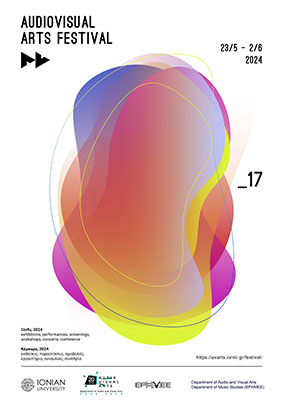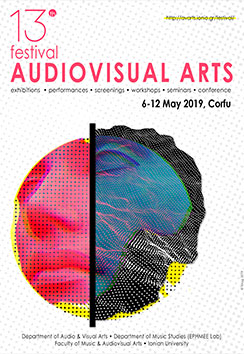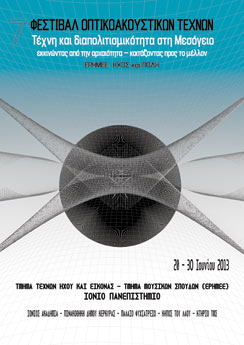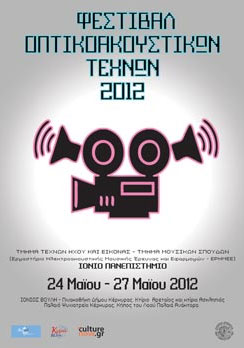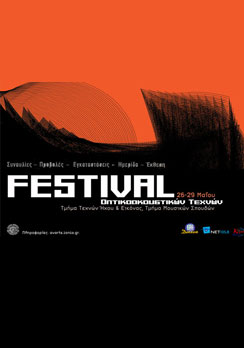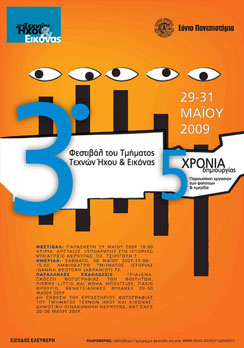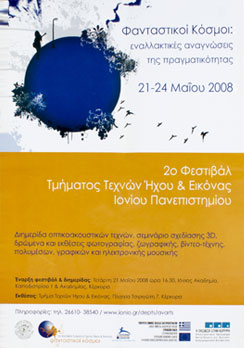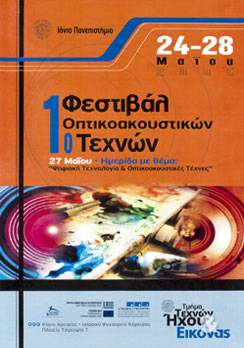
AKOUSMATA is the annual series of events presented by the Laboratory of Electroacoustic Music Research and Applications (ΕΡΗΜΕΕ) in collaboration with the Laboratory of Performance Environments in the Arts (PEARL) at the Festival of Audiovisual Arts organized by the Department of AudioVisual Arts of the Ionian University.
The program presents a selection of electroacoustic works by composer Gianluca Verlingieri, spanning from 2006 to 2026, and includes the World Premiere of Kinderscapes.
PROGRAM:
Fontana reMix (2006–2009) for fixed-media, 10’04’’
Berserk (2019) for fixed-media, 5’
Sonic Hops (2022) version for fixed-media and live-electronics ad lib., ca. 8’
Kinderscapes (2025–2026) for 8ch fixed-media, 8’ (World premiere)
Dante’s Songs (2015–2021) for quadraphonic fixed-media, 8’17’’
Suite from Requiem da Ballo (2018) for fixed-media, 12’30’’
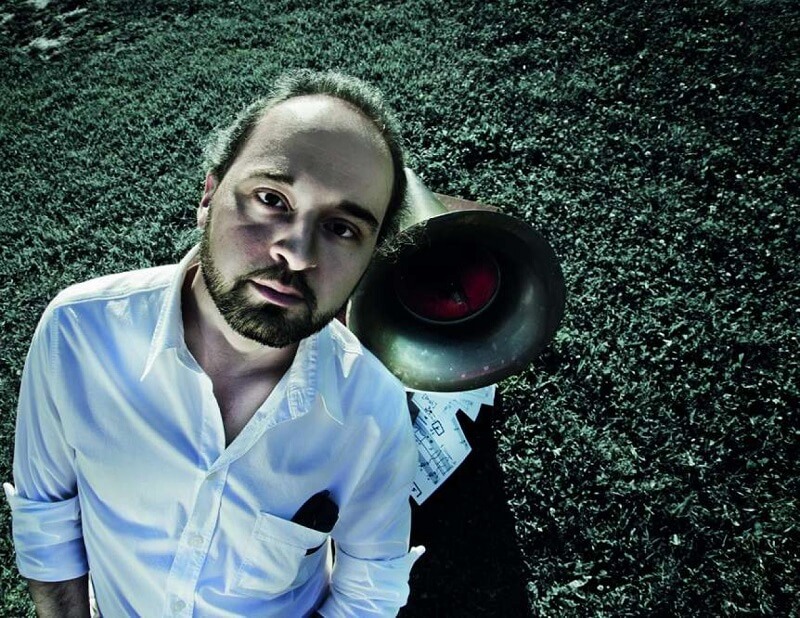
Gianluca Verlingieri is an internationally recognized composer whose work spans a wide array of creative fields, including concert compositions for soloists and ensembles, acousmatic pieces, live electronics, musical theater, and multimedia soundtracks. Hailed early in his career by Radio Classica as a highly promising artist, his music is today performed at prestigious global venues, such as the INA-GRM in Paris, Columbia University in New York, the Berlin Staatsoper, and the Aix-en-Provence International Festival.
His compositions have been broadcast by prominent networks like Radio France and NPR, and recorded by labels including BIS Records and Limen Music. Verlingieri has garnered numerous accolades throughout his career, including awards at the GRM Banc d'Essai, the IBLA Grand Prix, and the Italian National Arts Prize. Supported by a multi-year De Sono scholarship, he studied at leading Italian institutions such as the Accademia Nazionale di Santa Cecilia and the Accademia Chigiana. He frequently collaborates with world-renowned soloists and contemporary ensembles, including the Talea Ensemble, Bit 20 Bergen, and the Quartetto di Cremona.
In addition to his compositional output, Verlingieri is an active researcher. He was commissioned to catalog Luciano Berio's private sound archive at the Centro Tempo Reale in Florence and has conducted specialized research on Mauricio Kagel's musical theater and John Cage's magnetic tapes. Since 2011, he has been a Professor of Electroacoustic Musical Composition at the G. F. Ghedini Conservatory in Cuneo, Italy, where he has also served as the coordinator of the Department of New Technologies and Musical Languages since 2012.
Fontana reMix (2006–2009)
Fontana reMix (for fixed-media, 10’04’’) was conceived fifty years after John Cage’s Fontana Mix, engaging in a direct dialogue with the historical work without using its original sound materials, except for a brief quotation from the RAI Milan Studio di Fonologia Musicale tapes. Premiered in Mexico City in 2006, it was revised in 2009 for an international Cage conference in Parma, spatialized via a 189-loudspeaker Wave Field Synthesis system. The term "reMix" represents a dual operation: Verlingieri uses Cage’s original aleatoric graphic procedures but intervenes to restore a greater margin of composer decision-making regarding form and macrostructure. It becomes a dialectic between philological approach and contemporary reinterpretation. The sound material intertwines distant echoes of the 1950s soundscape with references to the early 2000s, blending the physicality of sound objects with their cultural meaning across different eras, creating a dynamic reflection on an electronic music foundational piece.
Berserk (2019)
Berserk (for fixed-media, 5’) originated from a request by the duo ŌTONN (AndreaSilvia Giordano, voice; Nicholas Remondino, percussion) for their album Two Crumbling Shapes. It is an original fixed-media composition based exclusively on materials supplied by the duo: a brief music-box sample and two unrelated improvisations (vocal and percussive). The initial sound world, already charged with the unpredictable energy of radical improvisation, is progressively deformed by Verlingieri. He fragments the music box—a symbol of childhood regularity—pushing it toward instability. Its rhythmic pulse cracks, accelerates, and stalls, transforming into a deranged machine. Similarly, the original improvisations are drawn into a spiral of metamorphosis, oscillating constantly between control and loss of control. The title alludes to the legendary Nordic warrior seized by a violent trance, while also reflecting the literal meaning of "berserk": violently frenzied, wild, crazed, and destructively deranged.
Sonic Hops (2022)
Sonic Hops (version for fixed-media and live-electronics ad lib., ca. 8’) is an interdisciplinary project developed with choreographer Raphael Bianco. Initially a cycle of twelve micro-compositions, each represents one of Kevin Kelly’s twelve "inevitable forces" shaping the future, such as sharing, filtering, and remixing. The sound materials derive entirely from recordings—some made with hydrophones—of Italian craft beer production stages: fermentation, boiling, bottling, and pouring. The title plays on "hop" as both a plant and a leap. Originally, each piece featured improvised choreography by Vincenzo Criniti, whose sensor-tracked movements interacted with the sound in real time. This concert version reorganizes selected micro-compositions into an autonomous acousmatic form with optional live-electronics. The transformational processes no longer depend on a physical dancer; instead, the electroacoustic performer acts as a virtual body, live-filtering, tracking, and remixing the sounds, ideally transferring the physical dance directly into the sound itself.
Kinderscapes (2025–2026)
Kinderscapes (for 8ch fixed-media, 8’) stems from an unrealized 2023 project conceived when Verlingieri’s sons were toddlers. Immersed in an intimate soundscape of pre-verbal sounds, crying, laughter, and the sonic exploration of toys and everyday objects, he sought to capture this unique, albeit sometimes obsessive, parental universe. Returning to the project in 2026, Verlingieri confronts time by contrasting amateur smartphone recordings of his children as toddlers with new, professional recordings of them at ages four and six, striving to preserve the spontaneity of play. Memory and the recording medium thus become integral to the piece. Adding a further temporal, autobiographical layer, the work features reflections of piano fragments from Schumann’s Kinderszenen. These fragments evoke not only the childhood depicted in Schumann's famous piano cycle but also another distinct childhood: that of Verlingieri himself as a young piano student.
Dante’s Songs (2015–2021)
Dante’s Songs (for quadraphonic fixed-media, 8’17’’) originates from unused vocal materials recorded for Tre Movimenti di Luce, a multimedia work commissioned by the 78th Maggio Musicale Fiorentino for Dante Alighieri’s 750th anniversary. Years later, Verlingieri repurposed these remaining vocal samples of singer/actress Chiara De Palo reciting lines from the Divine Comedy, making them the core of a new acousmatic composition. Detached from their original context, these fragments merge with the percussive "breathing" sounds of Antonella Bini’s contrabass flute and a vintage synthetic soundscape created using a rare EMS Synthi 100 at Ghent University’s Institute of Psychoacoustics and Electronic Music. In the video version, co-created with Colombian video artist Carlos Franklin, the electroacoustic work engages with frames from the 1911 silent film L’Inferno. These visuals undergo deliberate glitches, distortion, and algorithmic manipulation, mirroring the artefacts of the intricate sonic transformations.
Suite from Requiem da Ballo (2018)
Suite from Requiem da Ballo (for fixed-media, 12’30’’) derives from a 30-minute performance premiered at the Tempo Reale Festival following a residency at the Luciano Berio center. The original featured reciting voice, acousmatic projection, and live-electronics via custom "speaking pipes" made from recycled materials, acting as an electroacoustic vocal apparatus. For a later presentation in Manchester, Verlingieri reworked this into an autonomous 32-channel acousmatic version. Removing the physical vocal apparatus allowed the electroacoustic double concept to emerge more prominently. The fixed-media piece explores the relationship between source material—recordings of Southern Italian folk instruments by Mimmo Morello—and their synthetic shadows created in Kyma®. These synthetic sounds offer an expressive, rather than purely timbral, mimesis of the real instruments. The work merges the contemporary with the primitive, making modern synthetic sounds dance in a ritualistic rhythm alongside ancient acoustic gestures like Sardinian launeddas, jaw harps, and ephemeral Calabrian flutes.
| < | September 2026 |
|||||
| Mo | Tu | We | Th | Fr | Sa | Su |
1 |
2 |
3 |
4 |
5 |
6 |
|
7 |
8 |
9 |
10 |
11 |
12 |
13 |
14 |
15 |
16 |
17 |
18 |
19 |
20 |
21 |
22 |
23 |
24 |
25 |
26 |
27 |
28 |
29 |
30 |
||||