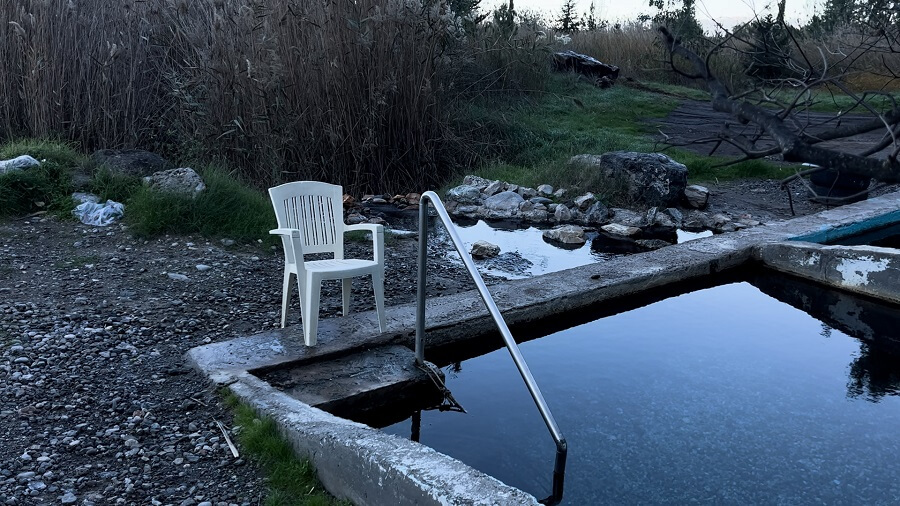
The work is structured through a spatial and temporal journey, where places from childhood coexist with spaces from a recent wandering. Movement through space activates initial images in both memory and the present. The archive functions as an active system of rewriting time, in dialogue with contemporary visual material. The use of a split image constructs simultaneous spatial and temporal conditions, allowing different places to coexist within the same visual field. Through this arrangement, space appears multiple and discontinuous.
The voice-over operates as a narrative carrier, connecting place with lived experience: the space of childhood, the mother, and a church in Ropoto, Trikala, which has tilted seventeen degrees yet remains standing. This specific site functions as a point of reference between memory and spatial continuity. The work proposes walking as a methodology for connecting space with memory, examining how the archive, image, and narration construct subjective geographies.
| < | October 2026 |
|||||
| Mo | Tu | We | Th | Fr | Sa | Su |
1 |
2 |
3 |
4 |
|||
5 |
6 |
7 |
8 |
9 |
10 |
11 |
12 |
13 |
14 |
15 |
16 |
17 |
18 |
19 |
20 |
21 |
22 |
23 |
24 |
25 |
26 |
27 |
28 |
29 |
30 |
31 |
|