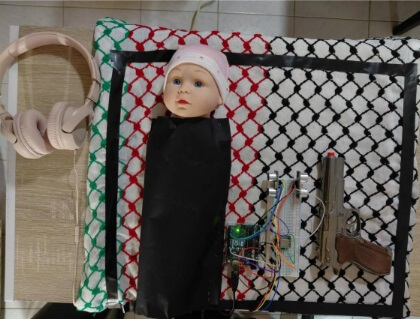
The work is an interactive installation that explores memory as an embodied and active process. At its centre lies a Palestinian keffiyeh, placed on a table as a symbol of both everyday life and resistance, extending beyond fixed borders to suggest a universal, shared space. Within a black frame—referencing a specific geographical territory—two objects are positioned: a baby and a weapon.
The installation is activated through the viewer’s participation. By wearing headphones, the viewer may lift the baby and hear sounds of children playing and fragments of daily life, or lift the weapon and encounter a sudden shift to sounds of war—sirens, explosions, and cries. The two objects can be engaged with in any order, functioning both independently and in relation to one another, revealing contrasting yet coexisting realities.
At the core of the work is the idea that memory is not passive, but enacted. It requires a body, a gesture, a decision. Memory comes into being only through the viewer’s action: by lifting, holding, and listening. The looping sound reinforces this condition—memory persists for as long as it is held, and falls silent when it is released. In this sense, memory becomes a bodily, ethical, and political act.
The work ultimately operates as a reflection on the ongoing genocide of the Palestinian people, foregrounding the urgency of personal responsibility in sustaining memory against collective erasure.
| < | October 2026 |
|||||
| Mo | Tu | We | Th | Fr | Sa | Su |
1 |
2 |
3 |
4 |
|||
5 |
6 |
7 |
8 |
9 |
10 |
11 |
12 |
13 |
14 |
15 |
16 |
17 |
18 |
19 |
20 |
21 |
22 |
23 |
24 |
25 |
26 |
27 |
28 |
29 |
30 |
31 |
|