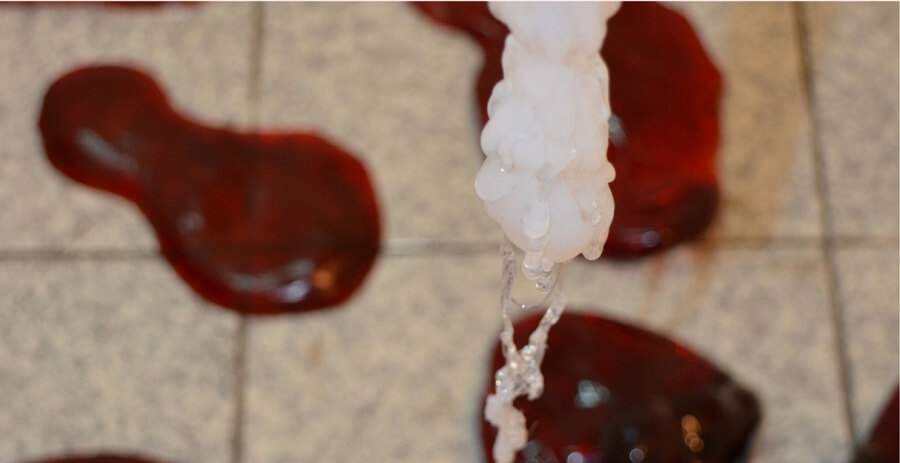
The installation unfolds as a dynamic field of flows that are interrupted, frozen, and reactivated. Across the floor, oversized translucent bloodstains made of resin appear as suspended traces of an unknown event. Rather than narrating a crime, they resist coherent interpretation, remaining in a state between evidence and speculation. Within this environment, certain elements are activated only through the viewer’s presence: a suspended stain is set into motion via a hidden mechanism, while a polyurethane mass emits vapor upon touch. These activation points are marked by fluorescent fingerprints, signaling the body’s role as a catalyst of flow.
The work draws on Deleuze and Guattari’s concept of “desiring-machines,” proposing reality not as a set of stable objects but as a network of continuous connections and interruptions. At the same time, it engages with bloodstain pattern analysis: while forensic science seeks to reconstruct events through traces, here legibility collapses, exposing the limits of objectivity.
Paintings and sculptural elements function as maps of potential relations rather than representations. The traces appear familiar yet resist classification, remaining in a state of ambiguity. The installation does not depict violence but interrogates its perception, transforming the trace from evidence into an active field of interpretation where flow and stasis coexist.
| < | June 2026 |
|||||
| Mo | Tu | We | Th | Fr | Sa | Su |
1 |
2 |
3 |
4 |
5 |
6 |
7 |
8 |
9 |
10 |
11 |
12 |
13 |
14 |
15 |
16 |
17 |
18 |
19 |
20 |
21 |
22 |
23 |
24 |
25 |
26 |
27 |
28 |
29 |
30 |
|||||