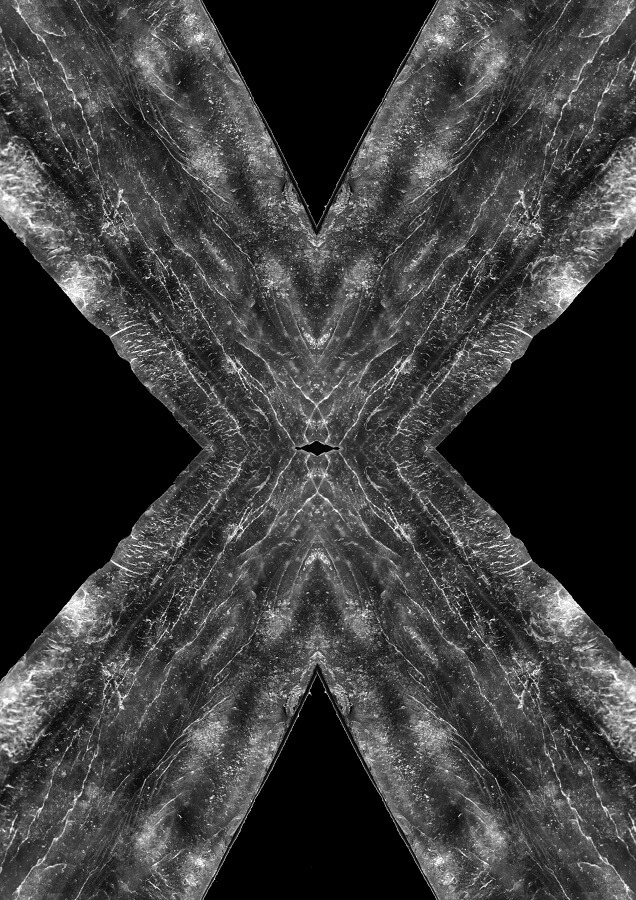
The visual component is based on a macro-photographic image of a natural fragment. Through macro-photographic observation and digital symmetrical transformation, the fragment is detached from its original physical form and enters a new visual condition. Organic forms emerge that retain traces of pressure, erosion, and time.
Within this newly formed visual field, a tension develops between the organic and the geometric, between natural decay and imposed order.
The resulting symmetry establishes both a point of convergence and a point of rupture, while the black background reinforces the sense of suspension. The fragment no longer belongs to the earth, detached from weight and assumes an almost astral presence.
The center remains ambiguous. At the point where the axes intersect, a small dark cavity appears, resembling an opening or possible entrance, while simultaneously evoking a sense of return, as if no escape were possible.
The sonic form is not structured around climax or linear progression. Instead, it unfolds as a process. Its morphological evolution unfolds through four sections—genesis, accumulation, diffusion, and decompression—which together create a temporal experience in constant relation to the stillness of the image.
Image and sound follow the same morphological logic: a shared structure, a common movement between tension and release, and a shared notion of transformation. The work functions as a unified environment in which space and time are structured through layers and textures.
| < | September 2026 |
|||||
| Mo | Tu | We | Th | Fr | Sa | Su |
1 |
2 |
3 |
4 |
5 |
6 |
|
7 |
8 |
9 |
10 |
11 |
12 |
13 |
14 |
15 |
16 |
17 |
18 |
19 |
20 |
21 |
22 |
23 |
24 |
25 |
26 |
27 |
28 |
29 |
30 |
||||