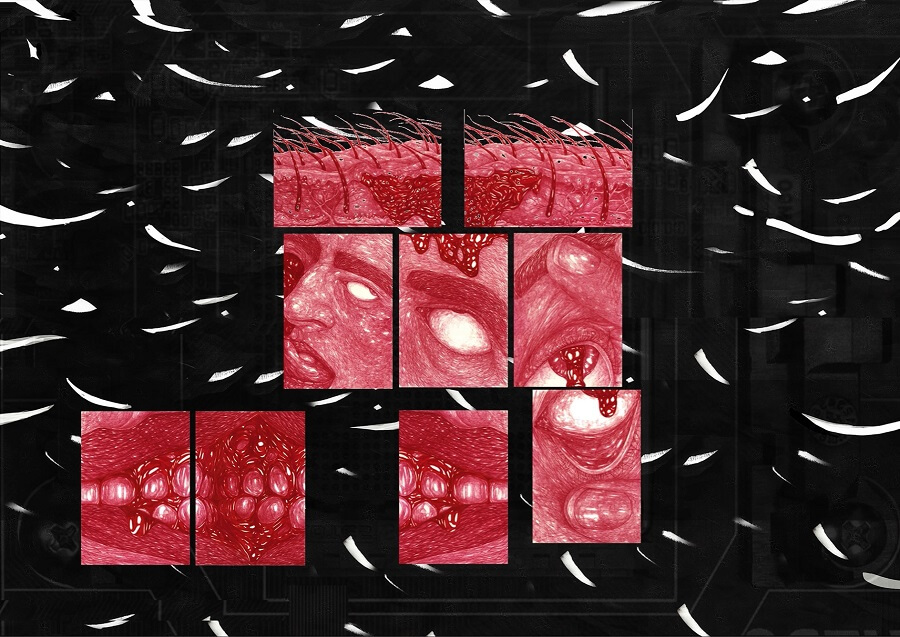
Bleeding Machine explores the relationship between violence, image, and narrative within a digital interactive environment. It is a non-linear work composed of nine drawings depicting fragmented parts of a face, primarily the eyes and the mouth, from which blood flows. These elements function as visual traces of a violent act whose cause remains unknown: the viewer cannot determine what happened, who caused it, where, or why. In this way, the work deconstructs the fundamental components of narrative (who, where, what, why, how) and proposes a form of storytelling based on displacement, disorientation, and repetition.
The structure of the work is interactive. Each of the nine drawings operates as a clickable element that leads the viewer to a different arrangement of the same images. These varying configurations generate nine alternative narrative shifts, none of which constitutes a definitive version of the story. The narrative remains open and circular, as the drawings move in a repeating loop, while the act of navigation itself is also reiterated. This formal approach seeks to simulate the lack of coherence that characterizes the experience of violence.
| < | June 2026 |
|||||
| Mo | Tu | We | Th | Fr | Sa | Su |
1 |
2 |
3 |
4 |
5 |
6 |
7 |
8 |
9 |
10 |
11 |
12 |
13 |
14 |
15 |
16 |
17 |
18 |
19 |
20 |
21 |
22 |
23 |
24 |
25 |
26 |
27 |
28 |
29 |
30 |
|||||