

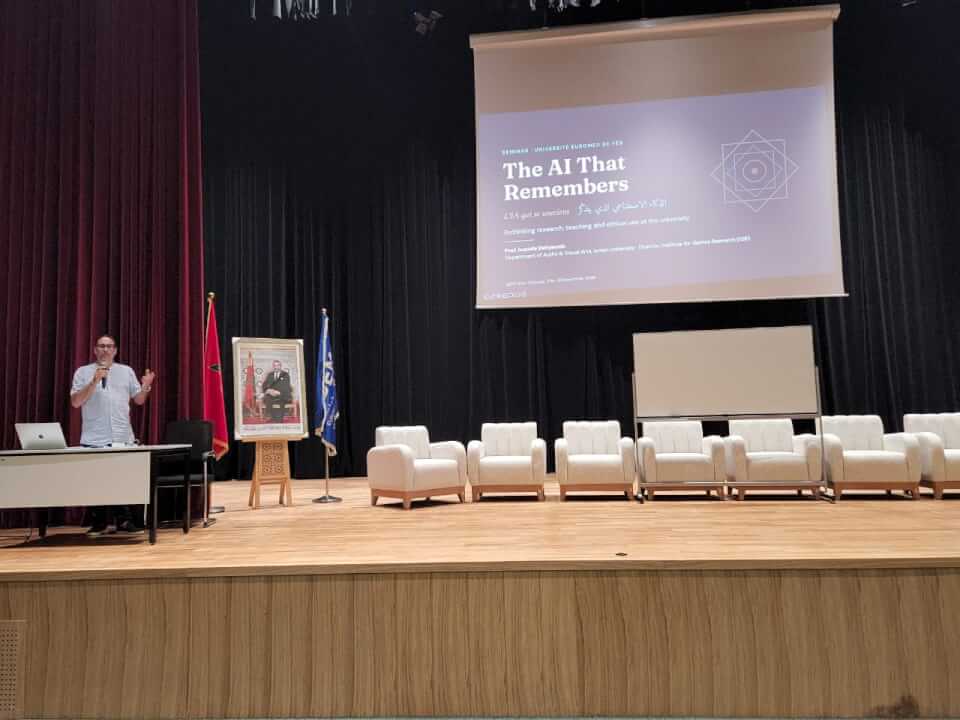
On Tuesday 10 November 2026, Ioannis Deliyannis, Professor in the Department of Audio and Visual Arts at the Ionian University and Director of the Interactive Games Research Institute (IGR), delivered a seminar today at the Université Euro-Méditerranéenne de Fès entitled “The AI That Remembers: Rethinking Research, Teaching and Ethical Use at the University.”
The lecture took place as a staff secondment under the European project REMARKABLE — Rural Environmental Monitoring via ultra wide-ARea networKs And distriButed federated Learning — funded by Horizon Europe through the Marie Skłodowska-Curie Actions – Staff Exchanges (Grant Agreement No. 101086387). The scientific lead for the Ionian University is Associate Professor Ioannis Karydis of the Department of Informatics. The Euro-Mediterranean University of Fes also participates in the same project as a partner, which places the collaboration between the two institutions within a wider network of eleven European and five African organisations.
The seminar was attended by students of the University — the majority of them doctoral candidates — together with members of the teaching and research staff. The presentation was delivered in English, with multilingual material in French and Arabic, and developed along three lines of argument:
Memory as a methodological question. The talk set out the difference between AI tools that forget at the end of every session and assistants with persistent memory, which accumulate knowledge of a researcher’s projects, methodological choices and literature over months — a matter of particular consequence for the long arc of a doctoral thesis.
The connection to scholarly sources. The central argument was that artificial intelligence should replace the mechanical part of research — searching for and locating sources — and not the writing or the critical appraisal. Formulating the research question, reading, interpreting, arguing and signing one’s name remain human responsibilities.
Ethics and assessment. The session addressed the ethical dilemmas universities now face and presented the Documented Capability Baseline, the speaker’s proposal for assessing academic work under conditions in which a text is no longer, by itself, evidence of knowledge — with direct application to doctoral supervision and support.
A live experiment with the audience. The seminar included a live experiment whose outcome was known in advance to no one. A researcher at the University, working in microbiology and antimicrobial resistance, supplied a topic and research questions of her own choosing. Over the course of the lecture, the system identified the field’s established terminology from the publications themselves, searched multiple scholarly databases, assembled and verified 187 publications on bacteriophage research in the Middle East and North Africa (2020–2026), and produced a full literature review with every reference checked against the official registries — identifying one retracted paper along the way and correcting errors in publication years and author names.
The result was presented and assessed by the researcher herself in front of the audience, making it clear that the final judgement on the quality and completeness of a review belongs to the person who knows the field.
The lecture also presented the initiative of the Ionian University, which from the 2026–27 academic year offers artificial intelligence courses to students across all its departments, with emphasis on applications as well as on ethics and risk management.
The Department of Audio and Visual Arts thanks the Euro-Mediterranean University of Fes for its hospitality and for the invitation.
Photographs from the event follow.

 Invitation letter