


The MARes in Hybrid Arts program of the Department of Audio & Visual Arts, Ionian University, cordially invites all interested parties to attend the public defense of the following Master’s thesis:
Thesis Title:
The Amphibian Atlas: Ways of Knowing a River
Candidate:
Nicolás Parise Schneider
Supervisor:
Tania Tsiridou
Date & Time:
15 September 2026 - 18:00 Greece / 12:00 Argentina & Chile
Join via Zoom:
https://ionio-gr.zoom.us/j/93374700735
Examination Committee
- Tania Tsiridou - EEP, Department of Audio and Visual Arts, Ionian University
- Dalila Honorato - Professor, Department of Audio and Visual Arts, Ionian University
- Iakovos Panagopoulos - Associate Professor, School of Applied Arts and Sustainable Design, Hellenic Open University
About the Thesis
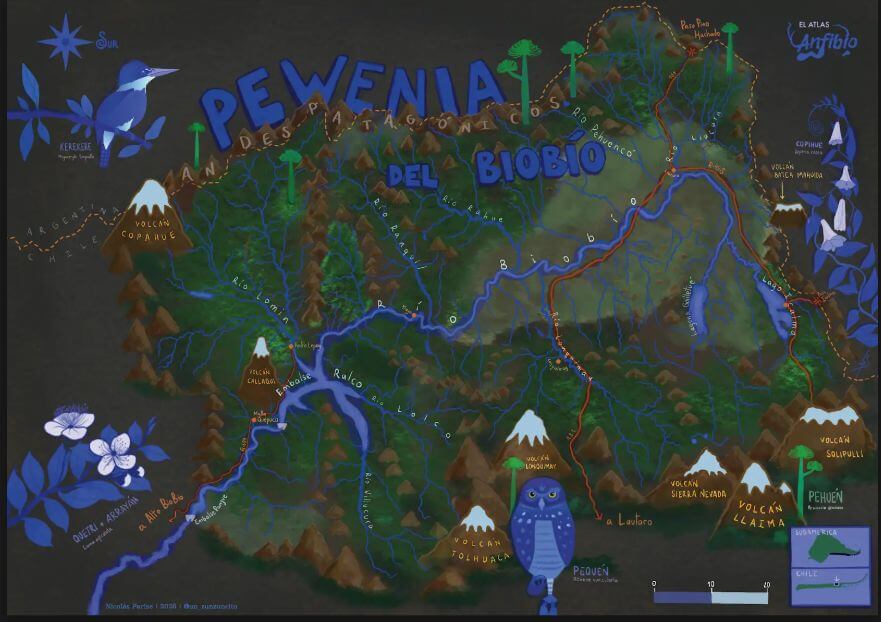
The Amphibian Atlas: Ways of Knowing a River is a research-creation project exploring how different forms of knowledge can contribute to understanding and representing a river. Developed through the Biobío River basin in Chile, the research brings together geography, artistic research, critical cartography, illustration, field encounters, and editorial practice. At its centre is The Amphibian Atlas, an illustrated publication conceived as a meeting point between different ways of knowing the Biobío: ecological and scientific knowledge, territorial experiences, community-based environmental monitoring, cartography, observation, drawing, and narrative. The Atlas is developed as an editorial contribution to Fundación Manzana Verde, a Chilean organisation working in the Biobío Region on environmental education, community participation, and the protection and monitoring of aquatic ecosystems. Through its work with Global Water Watch, the Foundation supports community-based water monitoring processes that enable local groups to observe, document, and better understand the ecological conditions of their rivers and watersheds.
Within this context, The Amphibian Atlas explores how artistic and editorial practices can contribute to environmental knowledge by making connections between forms of information that are often communicated separately. Rather than seeking a single or exhaustive representation of the Biobío, the Atlas constructs passages between partial and situated ways of knowing the river. The idea of amphibiousness emerges from this process as both a methodological and conceptual proposition: the capacity to move between different representational environments, disciplines, scales, and forms of attention while recognising the particular histories, limits, and forms of authority that each carries. Through the making of the Atlas, the thesis ultimately asks what representation can do when approached as a practice of encounter: how maps, illustrations, narratives, scientific observations, and territorial knowledge can coexist within an editorial object and contribute to more plural ways of knowing a river.
About the Candidate
Nicolás is an Argentine geographer, researcher, and illustrator based in Corfu, Greece. His practice develops at the intersection of geography, art, ecology, and critical cartography, with a particular focus on rivers and hydrosocial territories. Through fieldwork, illustration, mapping, editorial practice, and collaborative research, his work explores different ways of observing, representing, and communicating relationships between water, territories, communities, and ecological processes. He holds a degree in Geography from the National University of Cuyo, Argentina, and is completing the MARes in Hybrid Arts at the Department of Audio & Visual Arts, Ionian University. His work is informed by Latin American traditions of critical geography, critical extension, and situated and collaborative knowledge production, while developing dialogues with artistic research and ecological practices.
Attendance
The defense is open to the public. Students, researchers, artists, and all interested individuals are welcome to attend.